How to understand Bill Gates's AI warning about cyber, bio and jobs
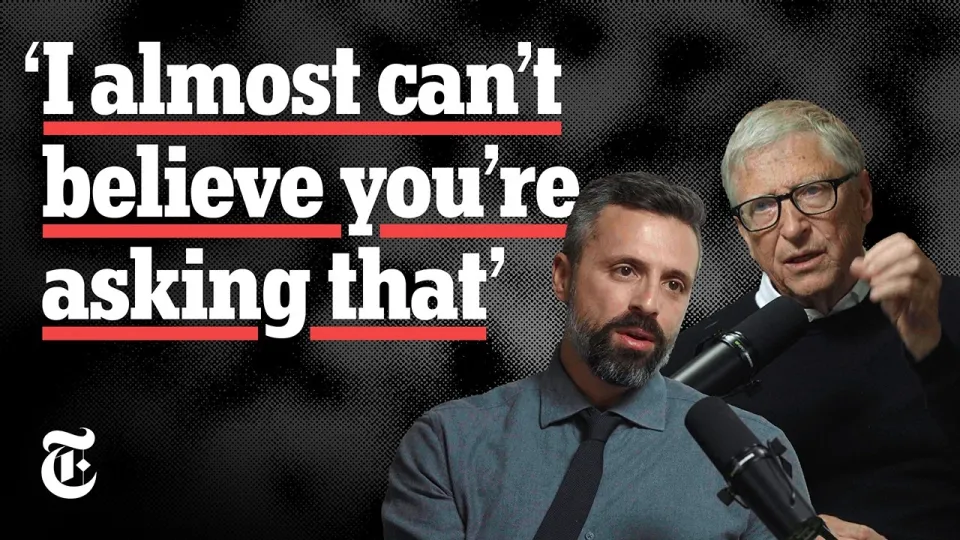
Video: Bill Gates: A.I. ‘Makes Nuclear Weapons Look Like Nothing’ | The Ezra Klein Show
You can order the same kind of articles for your own video to boost it on YouTube and Google. Just message the Telegram bot @sat_sit_bot. The bot writes and publishes the articles itself (with your YouTube video embedded) on popular topical websites (no ads). Your first 50 articles are free.
· based on the channel The Ezra Klein Show
Key takeaways
- Gates calls the idea that the AI industry can self-regulate "insane" and says liability lawsuits are no answer to a catastrophe that could kill 100 million people.
- He ranks AI as more dangerous than nuclear weapons and points to two near-term thresholds: catastrophic cyberattacks and bio-terrorism.
- Gates Foundation plans to spend down roughly $200 billion over the next two decades, with AI-driven inequality as a new priority.
- He warns of mass job loss and floats ideas such as taxing AI labor and "human reserved" roles.
- The interview aired on The Ezra Klein Show on September 29, 2026.
Bill Gates argues that artificial intelligence is the most dangerous technology humanity has approached, more threatening than nuclear weapons, and that governments — not the AI industry — must set hard limits on it. In his conversation with Ezra Klein, he names two near-term thresholds to fear, catastrophic cyberattacks and bio-terrorism, warns of mass job loss, and calls the notion that AI companies can police themselves "insane." The full transcript of the episode is available at the New York Times page for the Ezra Klein podcast.
What Bill Gates actually said about AI risk
Gates's core claim is that the danger is closer and more concrete than most policymakers admit. The title of the episode quotes him saying AI "makes nuclear weapons look like nothing," and the interview bears that out: he spends most of the hour on specific failure modes rather than abstract philosophy. Two thresholds matter most to him:
- Cyber. AI lowers the cost of finding and exploiting vulnerabilities, so attacks that once required a skilled team can be automated and scaled.
- Bio. Gates treats the possibility of AI-assisted bio-terrorism as the scarier of the two, because the consequences are measured in lives lost rather than data lost.
His framing is unusual for a technologist. Rather than arguing that innovation will outrun the risks, he argues that the people in positions of authority are in denial about what is coming, and that the gap between capability and governance is widening.
Why self-regulation fails, in Gates's account
The idea that the AI industry can regulate itself is, in Gates's word, "insane." His reasoning follows a familiar pattern from other industries: companies compete on speed, and the first mover to ship a capability gains an advantage that no voluntary pledge can offset. He is equally dismissive of relying on lawsuits after the fact. The line that landed hardest with listeners was essentially this: if a system kills 100 million people, you are not going to fix that through litigation.
That leaves regulation as the only lever he takes seriously, and he is explicit that it has to come from government. The comparison to nuclear weapons is not rhetorical decoration; it is an argument that AI belongs in the category of technologies where the state, not the vendor, sets the boundary.
The race with China and the safety trade-off
Gates does not treat regulation as a purely domestic question. A recurring tension in the conversation is the race with China: any slowdown by one country risks handing advantage to another, which is exactly the argument used to justify moving fast. Gates's response is that safety and competitiveness are not opposites, and that the race framing is often used to postpone rules that would cost little and prevent a great deal.
This is where the interview gets most contentious. Ezra Klein pushes on the gap between Gates's alarm and the industry's public optimism; Gates pushes back hard, and the exchange is one of the few moments where he visibly disagrees with the premise of a question rather than simply answering it.
How AI could disrupt work and widen inequality
Gates expects mass job loss, and he does not soften it. The discussion covers several distinct ideas rather than a single prediction:
- Displacement at scale. White-collar and cognitive work are exposed in a way earlier automation waves were not.
- A no-scarcity job market. If AI makes goods and services dramatically cheaper, the problem shifts from production to distribution — who gets to buy what.
- Taxing AI labor. Gates raises the idea of taxing automated labor as one way to fund the transition.
- "Human reserved" jobs. Some roles might be explicitly set aside for people, as a social and political choice rather than an economic one.
He also connects this to the developing world. The Gates Foundation, which is set to spend down around $200 billion over the next two decades, has made steering AI toward equality — rather than letting it amplify inequality — a new priority. His point about distance is the one that sticks: inequity persists partly because the people who could fix it are far from the people living with it.
AI in education and protection for children
Education is where Gates is most optimistic and most specific. He sees AI as a way to deliver personalized tutoring to students who would never otherwise afford it, and he points to learning loss in rich countries as evidence that the current model is failing many children regardless of technology. The caveat is regulation for children: he argues that minors need specific protections around AI products, separate from the rules that apply to adults.
Common questions listeners raised about the interview
Viewers came away with a few recurring doubts. One is tone: several noted that Gates seemed unusually agitated, and that his disagreement with Klein was visible rather than smoothed over. Another is comparison — the episode repeatedly invites the question of how his warning stacks up against the public optimism of AI hardware executives, who argue that market incentives will correct harmful products. Gates's answer is essentially that this has not held for past industries and will not hold here. A third is credibility: listeners pointed to the foundation's health work as evidence that his concern about bio risk and global inequality is not abstract. Finally, many asked what a private citizen can actually do — the practical answer from the conversation is to push for binding rules, because voluntary commitments and post-hoc lawsuits are the two options Gates rejects outright.
Useful links
- Full transcript of the Bill Gates episode on The Ezra Klein Show
- Book recommendations from guests of The Ezra Klein Show
The takeaway
Gates's position is not that AI should be paused, but that it is being deployed faster than any institution can govern it, and that the two risks most likely to cause mass casualties — cyber and bio — are already within reach. His prescription is unglamorous: binding government rules, specific protections for children, and deliberate policy to keep AI from widening the gap between rich and poor. The interview is worth reading in full at the transcript page, because the force of the argument comes from the specifics rather than the headline quote. This analysis draws on the conversation published by The Ezra Klein Show, whose interviews with technologists and policymakers are a useful benchmark for how the AI debate is shifting.
Questions & answers
Why does Bill Gates compare AI to nuclear weapons?
He argues that AI belongs in the small category of technologies whose worst-case outcome is measured in mass casualties, and that unlike nuclear weapons it is being developed by many private actors with little oversight. The comparison is meant to justify state-level regulation rather than voluntary industry pledges.
What does Gates mean when he says AI self-regulation is insane?
He means that voluntary commitments cannot survive competitive pressure: a company that slows down loses ground to one that does not. In his view only binding government rules change the incentives, and lawsuits after a catastrophe are not a remedy.
Which risks does he treat as most urgent?
Catastrophic cyberattacks and bio-terrorism. He describes both as near-term thresholds rather than distant scenarios, and treats the bio risk as the more severe because the human cost is direct and irreversible.
What does the Gates Foundation plan to do about AI and inequality?
The foundation is set to spend down roughly $200 billion over the next two decades, and Gates has made steering AI toward equality a new priority. The aim is to prevent the technology from widening gaps between rich and poor countries and communities.
Source: Bill Gates: A.I. ‘Makes Nuclear Weapons Look Like Nothing’ | The Ezra Klein Show · Markdown version